

 ဗမာစာ
ဗမာစာ
 Bahasa Indonesia
 ភាសាខ្មែរ
 Bahasa Melayu
 ภาษาไทย
 Tiếng Việt


Road and expressway development across the Philippines and Singapore continues to create demand for efficient construction methods, particularly where work must be completed within tight schedules or alongside existing traffic.
The operating environment differs between the two markets. The Philippines continues to develop and extend major expressway networks, while Singapore combines major transport projects with road upgrading, reinstatement and construction within a dense urban network.
In the Philippines, the 7.88 km Subsection 3 of the Cavite–Laguna Expressway opened in May 2026, while the opening of Contract Package 4 completed Phase 1 of the 29.2 km Central Luzon Link Expressway in March.
In Singapore, construction of the 21.5 km North–South Corridor remains underway. The Land Transport Authority reports that the project involves an 8.8 km viaduct and a 12.3 km tunnel section, with construction taking place close to existing roads, utilities and operational rail infrastructure.
Within this wider construction activity, concrete road barriers represent only one component. Where precast barriers are used, however, each unit may need to be loaded, transported, unloaded, repositioned and finally placed along the roadway.
When these lifting cycles are repeated across a large number of units, the method used to grip and handle each barrier can influence labour time, lifting cycles, component condition and overall site productivity.
Precast and Cast-in-Place Barriers Create Different Handling Requirements
Not all concrete road barriers are installed in the same way.
Some are cast continuously on site using specialised forming equipment. Others are manufactured as individual precast units and transported to the project.
The distinction matters from a lifting perspective.
A continuously cast barrier does not require each completed section to be lifted into position. A precast barrier, on the other hand, may pass through several handling stages between the precast yard and its final location.
This is where dedicated concrete barrier lifting equipment becomes particularly relevant.
How Are Precast Concrete Barriers Lifted?
There is no single lifting method for every precast barrier.
Depending on the barrier design and approved lifting arrangement, contractors may use built-in lifting points, lifting holes, slings, chains or purpose-built barrier clamps.
Where lifting points are incorporated into the unit, suitable lifting accessories can be connected before the crane takes the load. Other arrangements may involve slings or chains positioned around the component.
These methods remain practical for many applications, particularly where the barrier has been designed around a specific lifting arrangement.
The difference becomes more noticeable when the same operation has to be repeated throughout a shift.
If each lifting cycle requires workers to connect, position, check and then remove lifting accessories at the load, those individual steps accumulate as the number of barriers increases.
A purpose-built concrete barrier lifter approaches the operation differently by gripping a suitable section of the barrier directly.
How Does a Concrete Barrier Lifter Work?
A concrete barrier lifter is a lifting attachment connected to a crane or other suitable lifting system.
The crane provides the lifting force while the clamp holds the concrete unit.
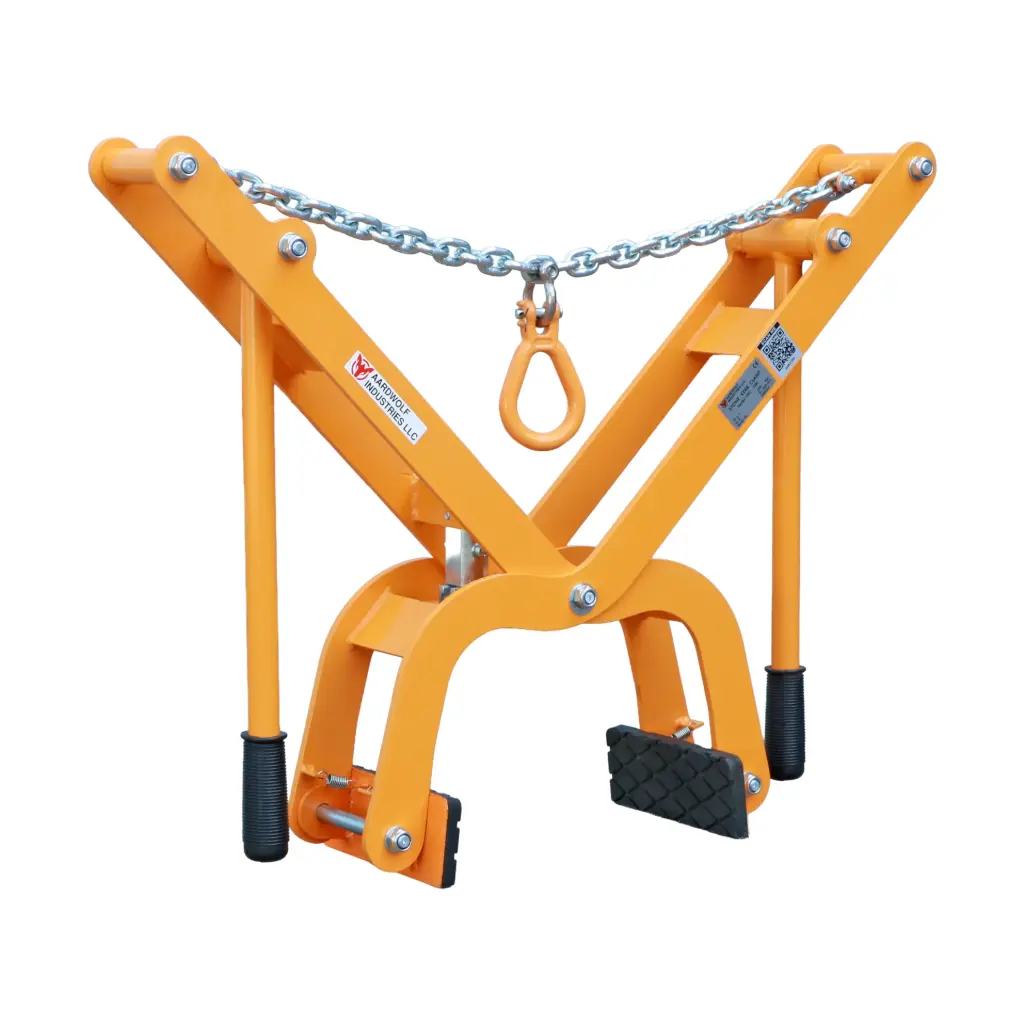
With an automatic mechanical clamp, the jaws are positioned around the barrier. As lifting begins, the mechanism engages and grips the load. Once the barrier has been lowered and the load is released, the mechanism can change to its release position.
A typical cycle can therefore be simplified to: Position the clamp → grip the barrier → lift and move → lower into position → release.
This becomes particularly useful where the same operation is repeated across many precast barrier units.
What Can a Barrier Lifter Add to a Project?
The value of a purpose-built barrier lifter is not simply that it can lift a concrete barrier. Cranes combined with suitable conventional lifting arrangements can already perform that task.
The more useful comparison is what happens around each lift.
Shorter Repetitive Handling Cycles
A lifting arrangement that requires accessories to be manually connected and removed introduces additional steps into every lifting cycle.
An automatic mechanical clamp can reduce some of these repetitive operations in suitable applications.
The difference on a single lift may be relatively small. Across dozens or hundreds of barrier units, however, the time associated with each cycle accumulates.
This makes cycle efficiency particularly relevant to barrier installation, precast yards, loading operations and projects where units are frequently repositioned.
Less Labour Time Spent Connecting and Releasing the Load
Ground personnel still have important roles in controlling the lifting area, monitoring the load and assisting with positioning.
The potential saving comes from reducing the time spent on repetitive attachment and release operations.
On projects involving a large number of lifting cycles, even relatively small reductions in handling time can accumulate into meaningful labour-hour savings.
Reduced Risk of Surface Damage
Precast concrete barriers arrive on site as finished components.
Chipped edges or surface damage during loading and installation can create additional repair work and, depending on the severity, may result in a component being rejected or replaced.
Purpose-built clamps can use contact surfaces designed specifically for gripping the component. Some designs use vulcanised rubber gripping pads to provide friction while reducing direct metal-to-concrete contact.
For projects handling a large volume of precast units, avoiding repeated minor damage can also reduce remedial work.
Where Does the Return on Equipment Investment Come From?
The purchase price tells only part of the story.
For repetitive barrier handling, the economic value of a lifting attachment can also be considered in terms of cycle time, labour hours, component damage and utilisation of the crane.
| Project consideration | Lifting arrangement requiring manual attachment at the load | Automatic barrier clamp |
| Lifting cycle | Additional attachment and release steps | Can reduce some load-side operations |
| Labour | Repeated attachment time for each lift | Can reduce time spent on repetitive operations |
| Concrete surface | Depends on accessory placement and protection | Purpose-designed gripping surfaces |
| High-volume work | Handling time accumulates with each lift | Time benefits become more relevant as cycles increase |
For a project involving only a small number of units, the difference may be limited.
The economics change when the same lifting process is repeated many times. Savings in cycle time and labour, together with reduced remedial work and more effective use of lifting equipment, can accumulate over the duration of the project.
This is why a dedicated barrier clamp tends to become more relevant as handling frequency increases.
Barrier Weight Is Only One Part of Equipment Selection
Two concrete barriers of the same weight do not necessarily require the same clamp.
The dimensions at the gripping point, component length, geometry, centre of gravity and contact surface can all affect compatibility.
Working Load Limit
The working load limit defines the maximum load the equipment is designed to handle under its specified operating conditions.
The actual weight of the concrete barrier therefore needs to fall within this limit.
However, load capacity alone does not indicate whether the jaws can accommodate the component.
Grip Range
Grip range defines the range of component thicknesses the jaws are designed to accommodate.
The relevant measurement is the actual thickness at the intended gripping point, rather than necessarily the maximum overall width of the barrier.
A barrier weighing 1,800 kg but measuring 280 mm at the gripping point would fall within the load limit but outside the clamp's grip range.
Weight and gripping dimensions therefore describe two different aspects of compatibility.
Length, Geometry and Centre of Gravity
Long precast components introduce another consideration: how the load is supported along its length.
Two barriers with similar weight and thickness can behave differently if their lengths, profiles or weight distribution differ.
This is one reason barrier lifting equipment is available in both single- and double-clamp configurations. Rather than simply increasing lifting capacity, a double-clamp arrangement changes the way the load is supported.
Contact Surface
The jaws make direct contact with the concrete, making surface condition another relevant factor.
Oil, contamination, irregular surfaces or worn gripping pads can affect the contact area between the clamp and the component.
The design and condition of the gripping surfaces therefore matter alongside load capacity and dimensions.
Matching Barrier Characteristics to Lifter Specifications
The relationship can be summarised relatively simply:
| Barrier characteristic | Relevant equipment specification |
| Unit weight | Working load limit |
| Thickness at gripping point | Grip range |
| Length and geometry | Clamp configuration |
| Centre of gravity and weight distribution | Gripping position |
| Contact surface | Jaws and gripping pads |
| Crane being used | Capacity of the complete lifting system |
This explains why comparing barrier lifters only by their maximum lifting capacity gives an incomplete picture.
Why the Equipment Manufacturer Matters
For equipment that directly supports heavy precast concrete during lifting, capacity and dimensions are only part of the purchasing decision.
Manufacturing experience, engineering, technical documentation, operating instructions, replacement parts and product support can all influence the equipment's value over its working life.
Aardwolf develops material handling and lifting equipment for stone, concrete and industrial applications. Its concrete barrier lifters combine mechanical clamping mechanisms with vulcanised rubber gripping surfaces and a range of lifting capacities and gripping dimensions.
For customers across Asia, Tool Range Asia provides access to Aardwolf equipment and technical product information, helping contractors and equipment buyers compare available configurations with their project requirements.
Explore Aardwolf Barrier Lifters at Tool Range Asia
Aardwolf Concrete Barrier Lifter Configurations
The differences between the available configurations become clearer when the specifications are viewed together.
| Model | Configuration | Grip range | Working load limit | Net weight |
| ABL255-2000 | Single clamp | 100–255 mm | 2,000 kg | 84 kg |
| ABL255-3000 | Single clamp | 100–255 mm | 3,000 kg | 146 kg |
| ABL360-5000 | Single clamp | 100–360 mm | 5,000 kg | 426 kg |
| ADBL-2000 | Double clamp | 155–250 mm | 2,000 kg | 264 kg |
The range is not simply a progression from lower to higher lifting capacity.
Some configurations maintain the same grip range while increasing load capacity. Another expands both grip range and lifting capacity, while the double-clamp design changes how the load is supported.
The actual dimensions and geometry of the barrier therefore provide more useful information than lifting capacity alone when comparing configurations.
Frequently Asked Questions
What is a concrete barrier lifter?
A concrete barrier lifter is a lifting attachment designed to grip suitable concrete barriers or precast components while they are being lifted and moved by a crane or other compatible lifting system.
How are precast concrete barriers commonly lifted?
Depending on the component design and lifting arrangement, precast barriers may be handled using built-in lifting points, lifting holes, slings, chains or purpose-built barrier clamps.
What are the main benefits of an automatic barrier clamp?
In repetitive lifting applications, an automatic clamp can reduce some of the manual attachment and release operations at the load. Potential benefits include shorter handling cycles, fewer labour hours spent on repetitive rigging operations and reduced direct metal contact with the concrete surface.
Is barrier weight enough to select a clamp?
No. Weight determines the required load capacity, while the thickness at the gripping point must fall within the clamp's grip range. Component length, geometry, centre of gravity and surface condition are also relevant.
What is the difference between a single and double barrier clamp?
A single clamp provides one gripping assembly, while a double-clamp system provides two gripping positions. The distinction relates to how the component is supported, particularly for suitable longer loads, rather than simply to lifting capacity.
Can a barrier lifter be used with every concrete road barrier?
No. Compatibility depends on the barrier's weight, dimensions, geometry, surface condition and the operating limits specified for the lifting equipment. Continuously cast concrete barriers do not involve the same individual-unit lifting process as precast barriers.
Why does the barrier lifter manufacturer matter?
A barrier lifter directly supports a heavy suspended load. Beyond basic capacity, factors such as engineering, manufacturing quality, technical documentation, replacement parts and product support can influence reliability and long-term equipment value.
When Repetition Turns Handling Time into Project Cost
For one isolated lift, differences between lifting methods may appear relatively small. On a project involving dozens or hundreds of precast units, those differences are repeated.
That is where a dedicated concrete barrier lifter becomes more interesting: not simply in how much weight it can carry, but in how it can streamline repeated lifting operations while helping protect the finished component.
Barrier weight, thickness, length and geometry define the technical requirements. Equipment quality, documentation and support add another dimension to long-term use.
Explore Aardwolf Concrete Barrier Lifters at Tool Range Asia for available configurations and technical specifications.